


Romania
Syllabus: GS1/Places in News
Context
- India and Romania have signed three agreements for cooperation in the fields of Science and Technology, Education and Sports.
About
- The agreements were signed after delegation-level talks between President Droupadi Murmu and her Romanian counterpart.
- India and Romania have set a target of doubling bilateral trade over the next three years.
About Romania
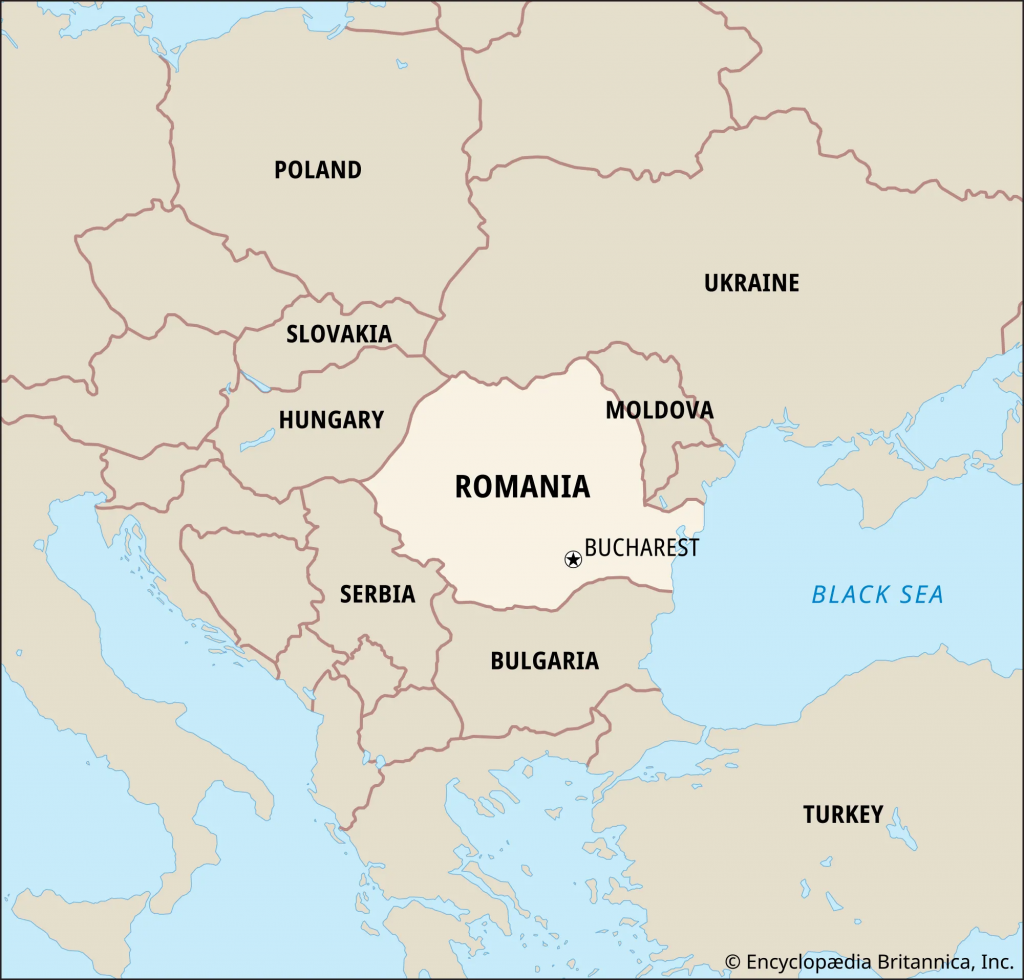
- Romania is a country of southeastern Europe. The national capital is Bucharest.
- It is bounded by Ukraine to the north, Moldova to the northeast, the Black Sea to the southeast, Bulgaria to the south, Serbia to the southwest, and Hungary to the west.
- The Danube Delta is the second-largest and best-preserved river delta in Europe, located primarily in Romania with a smaller portion in Ukraine.
- It is a UNESCO World Heritage Site, inscribed on the list in 1991.
- In 2004 the country joined the North Atlantic Treaty Organization (NATO), and in 2007 it became a member of the European Union (EU).
Source: AIR
DISHA 2.0
Syllabus: GS2/ Governance
Context
- The Union Government has launched DISHA 2.0 (Designing Innovative Solutions for Holistic Access to Justice) Scheme with a financial outlay of ₹255 crore for the period 2026–31 for pan-India implementation.
About DISHA 2.0
- It is a Central Sector Scheme of the Department of Justice, Ministry of Law and Justice.
- DISHA 2.0 aims at leveraging technology to develop and enhance the outreach of citizen friendly solution platforms for legal services.
Key Components of the Scheme
- The Tele-Law connects people with panel lawyers through mobile-app and Toll-Free No. for rendering pre-litigation legal advice and through use of video/tele conferencing facilities.
- Under Nyaya Bandhu (Pro-Bono Legal Services) Programme, advocates voluntarily provide legal assistance to marginalized and disadvantaged sections of society covered under Section 12 of the Legal Services Authorities Act, 1987.
- The Legal Literacy and Legal Awareness Programme (LLLAP) envisages engaging with institutions and building partnerships across stakeholder Ministries/Departments, to build capacity of the grassroot workers, legally empower them and spread legal awareness through workshops, webinars, IEC materials, collaboration with Prasar Bharati and others.
- VIDHI (Vision for Integrated Delivery of Harmonized Legal Initiatives) – Sanjeevani is envisaged as a key component under DISHA 2.0 to enhance the monitoring mechanism of the scheme through development and operationalization of a centralized Integrated Dashboard.
- The dashboard aims to provide a unified interface integrating real-time data streams from multiple sources to facilitate monitoring of the programme performance, service delivery and implementation progress.
Source: PIB
Rule 176 and Rule 267 of Rajya Sabha
Syllabus: GS2/Governance
In News
- Opposition members protested against the educational reform and gave a notice under Rule 267 in Rajya Sabha.
Rule 267 of the Rules of Procedure of Rajya Sabha
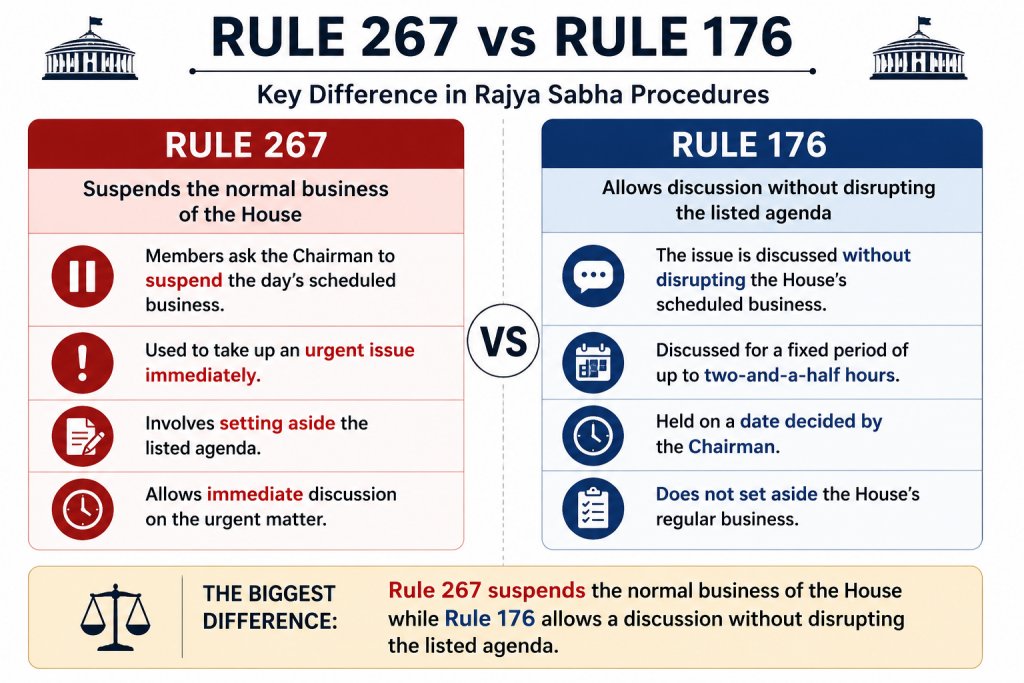
- It provides that with the consent of the Chairman, a member may suspend the normal business of the House and take up an urgent matter of public importance for immediate discussion.
- It’s a special procedure because it skips the list of business, and can only be done with the consent of the Chairman.
- This shall not apply to any specific chapter of the rules where separate provisions for suspension are provided.
Rule 176 of the Rajya Sabha Rules
- It permits a short-duration discussion on a matter of urgent public importance without disturbing the scheduled business of the House.
- Any member shall send to the Secretary-General a written notice, accompanied by an explanatory note and signed by at least two other members.
- If the Chairman agrees to the notice, the debate is scheduled in consultation with the Leader of the House and may last for up to two and a half hours.
Do you know?
- Lok Sabha Rules of Procedure Rule 193 deals with short duration discussion on a matter of urgent public importance.
- A member shall give written notice to the Secretary-General, with an explanatory note and the signatures of at least two other members.
- If the Speaker admits the notice, the debate is scheduled at a time fixed by the Speaker, usually on the advice of the Business Advisory Committee.
Source: BS
Geographical Indication (GI) Tags for ‘Unjha Cumin’ and ‘Unjha Fennel’
Syllabus: GS3/ Agriculture
Context
- Rajasthan’s cumin (jeera) and fennel (saunf) farmers have opposed the Geographical Indication (GI) registration of ‘Unjha Jeera’ and ‘Unjha Fennel’.
About
- Unjha is one of Asia’s largest agricultural markets for seed spices, especially cumin (jeera), fennel (saunf), and isabgol.
- A substantial quantity of jeera and saunf traded in the Unjha APMC originates from Rajasthan.
- Rajasthan farmers argue that Unjha in Gujarat is primarily a trading and marketing hub rather than the main production centre for these seed spices.
Geographical Indication (GI)
- A geographical indication (GI) is a sign used on products that have a specific geographical origin and possess qualities or a reputation that are due to that origin.
- In order to function as a GI, a sign must identify a product as originating in a given place.
- Geographical indications are typically used for agricultural products, foodstuffs, wine and spirit drinks, handicrafts, and industrial products.
GI Tags and India
- The Geographical Indications of Goods (Registration and Protection) Act,1999 seeks to provide for the registration and better protection of geographical indications relating to goods in India.
- The Act is administered by the Controller General of Patents, Designs and TradeMarks, who is the Registrar of Geographical Indications.
- The registration of a geographical indication is valid for a period of 10 years.
Source: IE
BHAVYA – Rasayan Scheme
Syllabus: GS3/Economy
In News
- The Union Cabinet chaired by the Prime Minister, has approved Bharat Audyogik Vikas Yojana Rasayan or BHAVYA – Rasayan Scheme for establishing three dedicated Chemical Parks in the country.
About BHAVYA – Rasayan Scheme
- The Scheme was announced in the Union Budget of FY 2026–27 with an outlay of ₹3,030 crore (₹3,000 crore for infrastructure and ₹30 crore for administration) over the period of five years (FY 2026-27 to FY 2030-31).
- Union Government will provide up to Rs. 1,000 crore per park, subject to a minimum contribution of Rs. 500 crore by the respective State Government.
- Each park will be developed through a Challenge Route of minimum 2,000 acres (8 sq. km.) with plug and play infrastructure comprising Common Effluent Treatment Plants (CETP), Treatment, Storage and Disposal Facilities (TSDF), water supply systems, solvent recovery units, steam networks, inter-connected pipelines and logistics and warehousing facilities.
Benefits
- It will lead to enhanced cost competitiveness, and it will make the Indian Industry globally competitive.
- It will promote the development of the Indian Chemical industry sustainably by creating an environment-friendly ecosystem which will consist of centralized facilities such as a Common Effluent Treatment Plant, Treatment, Storage, and Disposal Facility, and Hazardous Waste Management infrastructure.
- It will help the Indian Chemical industry better integrate in Global Value Chains, leading to greater exports and higher import substitution.
- It will ensure better compliance management with environmental regulations, thereby promoting development of the industry in an eco-friendly manner
- It shall facilitate development of the sector by attracting domestic and foreign investments, enhancing domestic production capacity and generating employment.
- It will boost the global competitiveness of the sector, thereby promoting Atmanirbharta.
Source: PIB
PRAXIS Mission
Syllabus: GS3/Science and Technology
Context
- NASA has selected PRAXIS, an innovative mission concept to develop the first spacecraft capable of directly collecting and studying particles from planetary rings, such as those around Saturn.
What is PRAXIS?
- PRAXIS stands for Planetary Rings Autonomous EXploration with In-situ Sampling.
- It proposes a bio-inspired robotic spacecraft powered by Artificial Intelligence (AI).
- It aims to become the first mission to directly collect samples from planetary ring particles.
- Key Features:
- Bio-inspired robotic explorer: Designed to mimic efficient movement and adaptability found in nature.
- AI-driven autonomy: Uses AI to identify suitable ring particles, plan sampling operations, and analyze collected data with minimal human intervention.
Source: TH
Kusha Missile
Syllabus: GS3/Defence
In News
- The Defence Research and Development Organisation (DRDO) has successfully conducted the maiden flight test of the Long-Range Surface-to-Air Missile (SAM) Kusha from Dr APJ Abdul Kalam Island off the coast of Odisha.
Kusha Missile system
- It is an indigenous long-range SAM system that will protect strategic military and civilian assets and infrastructure from a range of aerial threats.
- It is capable of neutralising a wide variety of aerial threats including fighter jets, missiles, unmanned aerial vehicles and large enemy aircraft within a wide range & altitude envelope.
- A long-range SAM typically has a range of over 200 km.
- All weapon system elements, including the missiles, radars, command and control centre, have been developed by various DRDO laboratories and Industry partners.
- It is a part of the Mission Sudarshan Chakra, India’s ambitious national defense initiative to build an interlocked, multi-layered, AI-enabled air and missile defense shield by 2035.
Do you know?
- In 2025 , the DRDO successfully conducted maiden flight tests of the Integrated Air Defence Weapon System (IADWS) — a multi-layered air defence system comprising all indigenous Quick Reaction Surface to Air Missiles (QRSAM), Advanced Very Short Range Air Defence System (VSHORADS) missiles, and a high-power laser-based Directed Energy Weapon (DEW).
- India operates the Russian S-400 Triumf, which is understood to be capable of hitting targets up to 400 km away.
Source: IE
England to Host First-Ever Mixed Disability Ashes in 2027
Syllabus: Miscellaneous
Context
- England and Australia will contest the first-ever Mixed Disability Ashes in 2027.
What is the Mixed Disability Ashes?
- It is the inaugural Ashes series between the England Men’s Mixed Disability Team and the Australia Men’s Mixed Disability Team.
- The series will be played in the T20 International (T20I) format.
- It will be part of England’s 2027 Ashes summer, alongside the men’s and women’s Ashes series.
- Mixed Disability Cricket is an inclusive format in which players with different disability classifications compete together in the same team under a common set of playing conditions.
History of the Ashes
- The Ashes is one of the oldest bilateral cricket series in international cricket, contested between England and Australia. It originated in 1882.
- Origin of the Ashes:
- In August 1882, Australia defeated England for the first time on English soil at The Oval, London.
- Following the defeat, the British newspaper The Sporting Times published a satirical obituary declaring that “English cricket had died, the body will be cremated and the ashes taken to Australia.”
- This phrase captured public imagination and gave rise to the name “The Ashes.”
- Evolution of the Series:
- Initially, the Ashes consisted only of Test matches between the men’s teams of England and Australia generally every two years.
- Women’s Ashes: First played in 1934–35, contested by the women’s national teams of England and Australia.
- Blind Ashes: Inaugurated in 2004, featuring the blind cricket teams of England and Australia.
- Mixed Disability Ashes: The inaugural edition will be held in 2027.
Source: DD News
Previous article
Invasive Species Threaten Global South Biodiversity
Next article
Sarnath Added To UNESCO World Heritage List
